



We use our shoulders more often than we realise. From getting dressed and washing our hair to reaching for something on a high shelf, these everyday movements rely on our shoulders working properly. But what happens when something as simple as lifting your arm starts to hurt?
Shoulder pain when reaching overhead can develop for several reasons, from rotator cuff injuries and bursitis to frozen shoulder and arthritis. While some cases improve with rest and simple adjustments to daily activities, others require medical attention.
So, what could your shoulder pain be telling you, and how do you know when it's time to see a doctor? Let's take a closer look at the possible causes, symptoms and treatment options.

The shoulder is one of the most mobile joints in the body, allowing us to lift, rotate and move our arms in almost every direction. This range of motion relies on several structures working together:
When you reach overhead, the upper arm and shoulder blade move together while the surrounding muscles maintain stability. If any of these structures become irritated, injured or stiff, raising your arm can become painful or difficult.
This doesn't necessarily mean something is torn or trapped. Shoulder pain can also develop from repetitive strain, changes in tendon health or reduced joint mobility.
Shoulder pain when lifting your arm can stem from several conditions affecting the muscles, tendons and joints. Although the symptoms often overlap, certain differences in pain, weakness and stiffness can help narrow down the possible cause.
| Condition | What it is and how it affects movement |
| Rotator cuff tendinopathy | Changes or irritation affecting the rotator cuff tendons, often associated with repetitive strain or ageing. Typically causes pain along the outer shoulder or upper arm, especially when reaching overhead or lying on the affected side. |
| Subacromial bursitis | Inflammation of the bursa that cushions the rotator cuff. Can cause pain when raising the arm or lying on the affected shoulder. |
| Rotator cuff tear | A partial or complete tear of one or more rotator cuff tendons. Can cause pain, weakness and difficulty lifting the arm, especially following an injury. |
| Frozen shoulder (adhesive capsulitis) | Thickening and tightening of the shoulder joint capsule, resulting in progressive stiffness and difficulty moving the arm, even with assistance. |
| Subacromial pain syndrome (shoulder impingement) | A broad term for pain involving structures around the rotator cuff and subacromial space. Often causes discomfort when lifting the arm, especially through certain ranges of movement. |
| Shoulder arthritis | Wear and degeneration of the shoulder joint cartilage, commonly causing pain, stiffness and reduced mobility. |
| Shoulder instability or labral injuries | Damage to the structures that stabilise the shoulder joint. Can cause deep shoulder pain, catching sensations or a feeling that the shoulder might slip out of place. |
One important distinction is that these conditions cannot be diagnosed based on pain alone. For example, both rotator cuff tendinopathy and a rotator cuff tear can cause pain when lifting the arm, but significant weakness following an injury raises greater concern for a tear.
Where you feel shoulder pain can offer clues about what's causing it. However, different shoulder conditions can produce pain in similar areas, so the location alone isn't enough to confirm a diagnosis.
| Location of pain | What it could indicate |
| Front of the shoulder | Often associated with biceps tendon problems or rotator cuff conditions. Pain can worsen when reaching forward or lifting objects. |
| Outer shoulder or upper arm | Common with rotator cuff tendinopathy, tears or bursitis. Pain often becomes more noticeable when raising the arm sideways or overhead. |
| Top of the shoulder | Can indicate acromioclavicular (AC) joint arthritis or injury, especially if reaching across your chest causes discomfort. |
| Deep within the shoulder | Can occur with shoulder arthritis, labral injuries or instability, sometimes accompanied by stiffness, catching or clicking sensations. |
| From the neck into the shoulder or arm | Can suggest cervical spine problems, including nerve irritation, especially when accompanied by tingling, numbness or radiating pain. |
Pain patterns are useful starting points, but a physical examination is needed to distinguish between conditions with overlapping symptoms.
Diagnosing shoulder pain begins with understanding where the pain occurs, which movements trigger it and whether it developed gradually or followed an injury. Your orthopaedic specialist will also assess how the pain affects your shoulder strength, mobility and everyday activities. Depending on the findings, your doctor may recommend imaging tests to investigate further.
Not everyone with shoulder pain needs imaging. In many cases, a clinical examination provides enough information to guide initial treatment.
Treatment for shoulder pain depends on the underlying condition, the extent of the injury and how much it affects daily activities. Most cases can be managed without surgery, although more serious injuries or persistent symptoms may require surgical intervention.
Non-surgical treatment typically involves activity modification, pain relief medication and physiotherapy to improve shoulder strength and mobility. In some cases, corticosteroid injections can provide short-term pain relief, while platelet-rich plasma (PRP) injections may be considered for selected tendon conditions.
Surgery is considered when shoulder pain results from significant structural damage, recurrent instability or advanced joint degeneration. It can also be appropriate when symptoms persist despite a suitable course of non-surgical treatment.
Depending on the underlying condition, surgical options include:
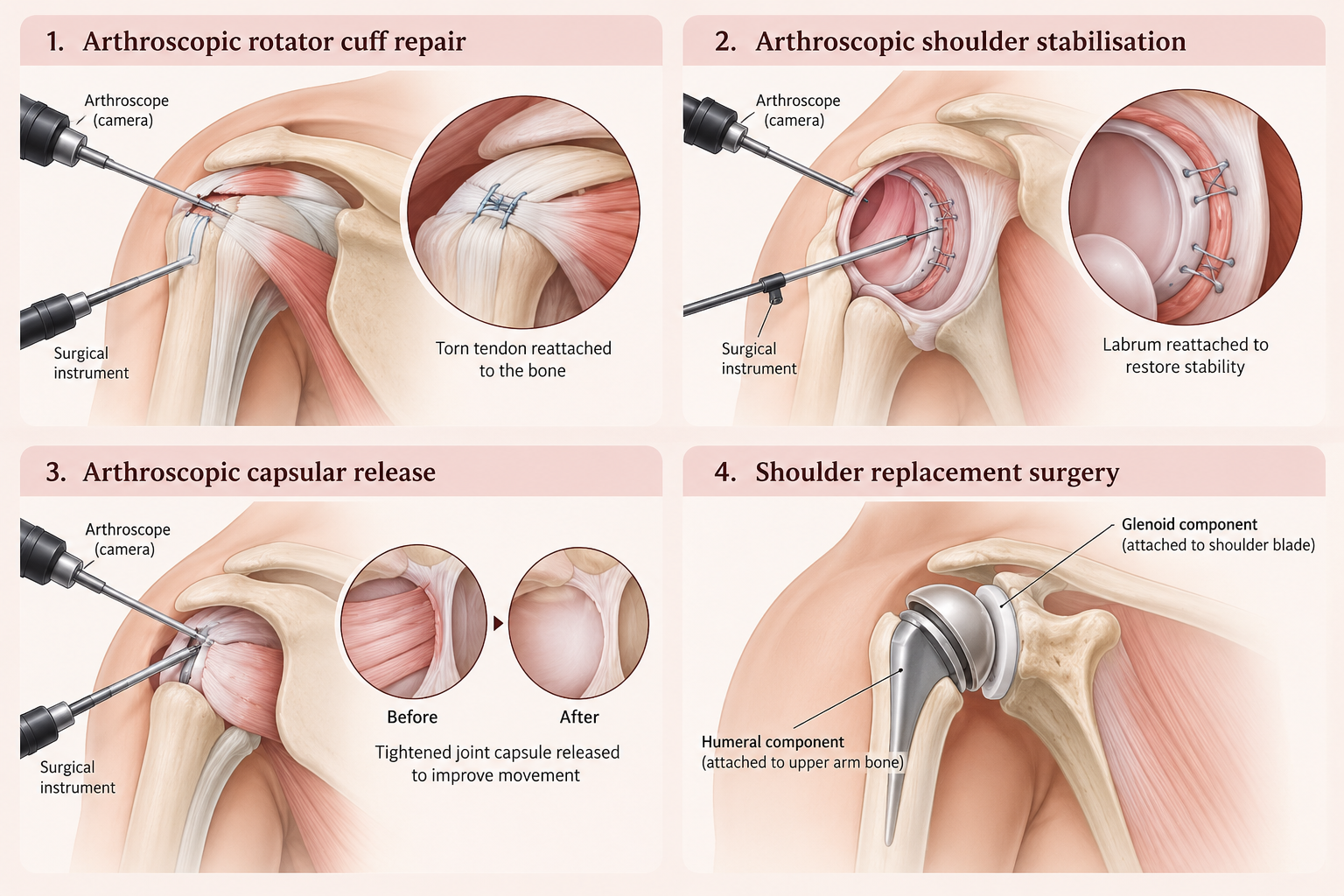
Shoulder injuries don’t always require surgery. Your orthopaedic surgeon will assess the underlying condition, imaging findings, shoulder function and treatment history before determining whether an operation is appropriate.
Oftentimes, shoulder pain improves with rest and simple adjustments to daily activities. However, it's worth getting your shoulder checked if you experience:
| When is shoulder pain an emergency? Seek urgent medical attention if you experience severe pain following an injury, visible shoulder deformity, sudden inability to move your arm, or a hot, swollen shoulder accompanied by fever.Shoulder pain accompanied by chest pain, shortness of breath, cold sweats or faintness requires emergency medical attention, as these can be signs of a heart-related problem. |
The first step towards relieving shoulder pain is understanding what's causing it so you can receive the right treatment. While mild discomfort often improves with rest and activity modification, persistent pain, weakness or restricted movement can indicate an underlying condition that requires medical attention.
If shoulder pain is affecting your daily activities or isn't improving, schedule a consultation with Dr James Tan for a thorough shoulder assessment and treatment tailored to your condition.
Yes, mild shoulder pain caused by temporary overuse or muscle strain often improves with rest, activity modification and gentle movement. However, if the pain persists for more than two weeks, worsens or affects your ability to lift your arm, it's worth seeing a doctor to identify the cause.
Lifting your arm places additional demands on the rotator cuff, tendons and surrounding shoulder structures. If these tissues are irritated or injured, you might experience pain during movement even when your shoulder feels comfortable at rest. This is common with rotator cuff-related conditions and bursitis.
You can often continue exercising with some modifications, provided the movements don't significantly aggravate your symptoms. Avoid heavy overhead lifting or exercises that cause sharp pain, and gradually resume your usual activities as your shoulder improves. If you experience significant weakness or worsening pain, seek medical advice before continuing.
Recovery depends on the underlying condition. Mild muscle strains can improve within a few weeks, while rotator cuff injuries and frozen shoulder can take several months or longer to recover. The extent of the injury, treatment approach and rehabilitation progress also influence recovery time.
Yes. Shoulder pain can develop gradually without a specific injury, often due to repetitive movements, age-related tendon changes or conditions such as frozen shoulder and arthritis. Symptoms might initially appear only when lifting your arm or reaching overhead before becoming more noticeable during everyday activities.

Get in touch with Orthopaedic Specialist Dr James Tan today to discuss your concerns and explore the best treatment options for your bones, joints, muscles and spine.


Monday - Friday: 8:30am - 5:30pm
Saturday: 8:30am - 12:30pm
Sunday & Public Holiday: Closed


