


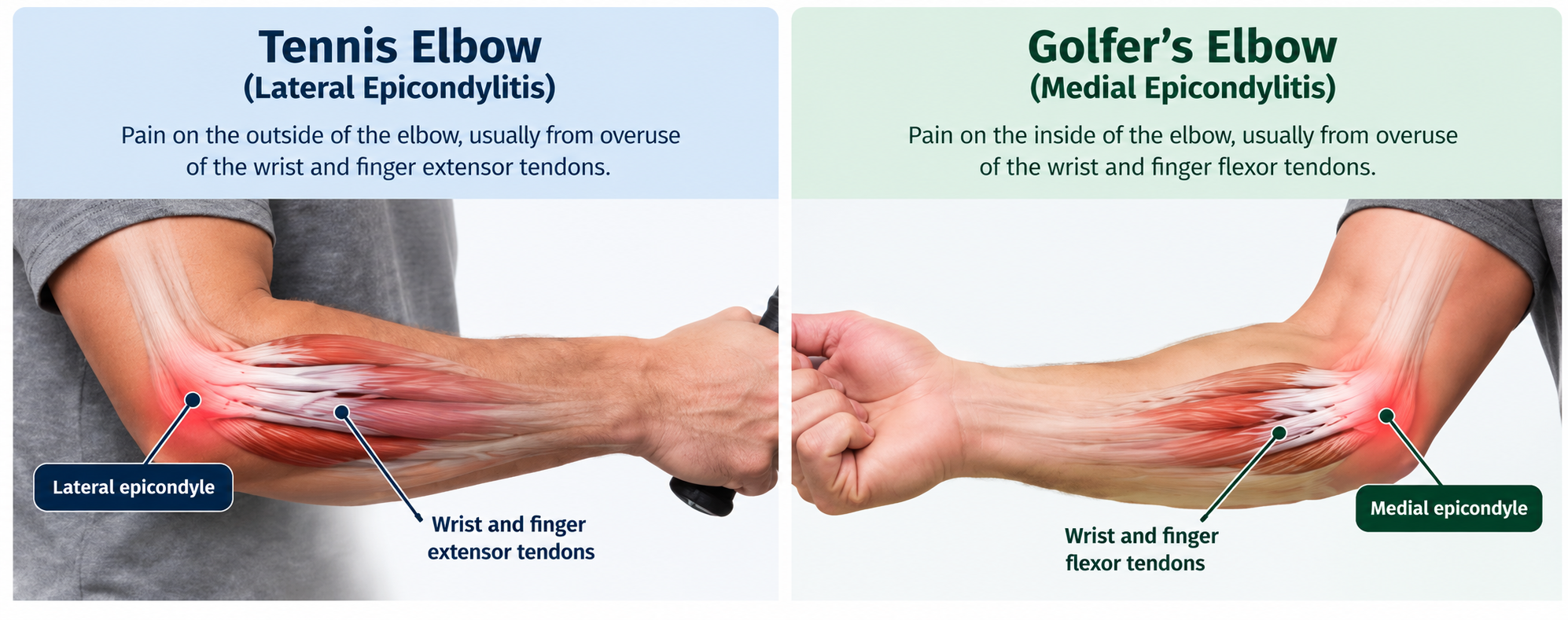
You have elbow pain when you grip, lift or move your wrist. But is it tennis elbow or golfer’s elbow?
Despite their names, you don’t need to play either sport to develop these conditions. Both affect tendons around the elbow and can cause pain during everyday activities, but there is one key difference: tennis elbow typically causes pain on the outside of the elbow, while golfer’s elbow affects the inside.
The location of your pain can therefore provide a useful first clue. However, not all elbow pain follows the same pattern, and persistent or unexplained symptoms may need further assessment.
The location of the pain is often the first clue. Tennis elbow affects the outer side of the elbow, while golfer’s elbow affects the inner side.
| Feature | Tennis elbow | Golfer’s elbow |
| Medical term | Lateral epicondylitis | Medial epicondylitis |
| Where is the pain? | Outside of the elbow | Inside of the elbow |
| Main tendon group | Wrist and finger extensor tendons | Wrist and finger flexor tendons |
| Tender point | Outer bony prominence of the elbow | Inner bony prominence of the elbow |
| Typical wrist movement | Wrist extension | Wrist flexion |
| Pain may spread into | Outer forearm | Inner forearm |
| Common triggers | Gripping, lifting, wrist extension and repetitive hand use | Gripping, lifting, wrist flexion, throwing and repetitive forearm use |
This difference comes down to which tendons are affected. Tennis elbow involves tendons connected to muscles that extend the wrist and fingers, while golfer’s elbow involves those that flex them.
Tennis elbow affects the tendons that attach to the bony prominence on the outside of the elbow. These tendons connect to muscles that extend the wrist and fingers, which is why gripping, lifting and certain wrist movements can trigger pain.
The pain may stay around the outer elbow or extend into the forearm. You may notice it when you:
You may also notice that your grip feels weaker, particularly when lifting or holding objects.
Golfer’s elbow affects the tendons that attach to the bony prominence on the inside of the elbow. These tendons connect to muscles used to flex the wrist and fingers, so pain often becomes more noticeable during gripping, lifting or wrist flexion.
The discomfort can remain around the inner elbow or travel down the inner forearm. Common triggers include:
Despite the name, golf is only one possible trigger. Activities at work, in the gym or during everyday life can place similar demands on these tendons.
Both conditions affect tendons around the elbow and can cause pain during gripping, lifting and other everyday movements. These activities rarely rely on just one muscle or tendon group, so there can be some overlap in how the symptoms feel.
For example, lifting a heavy bag requires several forearm muscles to work together. If one of the tendons is already irritated, the movement can hurt even if it does not specifically involve wrist extension or flexion.
Symptoms can also develop gradually, making it difficult to pinpoint exactly when the problem started. This is why where the pain is located is an important clue, but not enough on its own to make a diagnosis.
Both conditions can develop when the tendons around the elbow are repeatedly placed under more strain than they can adapt to. This can happen gradually through work, exercise, sport or other repetitive activities.
The difference lies in which tendon group is affected:
Symptoms do not always follow a specific injury. A sudden increase in training, heavier lifting or a new repetitive task can place unfamiliar demands on the tendons and trigger pain. In some cases, symptoms can also begin after an acute injury.
Diagnosis usually starts with a discussion of your symptoms and a physical examination. Dr James Tan will look at where the pain occurs, what tends to trigger it and whether there are other symptoms such as weakness, numbness or restricted movement.
During the examination, Dr Tan may use several tests to reproduce the pain and identify which tendon group is affected:
Dr Tan may also assess the elbow, wrist and neck or perform nerve tests when the symptoms suggest another possible cause.
Imaging is not always necessary when the symptoms and examination findings are typical. If the diagnosis is unclear, the doctor may recommend an X-ray, ultrasound or MRI to assess the elbow further or rule out another condition.
Treatment for tennis elbow and golfer’s elbow follows similar principles. In both cases, the aim is to reduce strain on the affected tendon, manage pain and gradually restore strength. The main difference is which tendon group the treatment targets.
Most people start with non-surgical treatment, which may include:
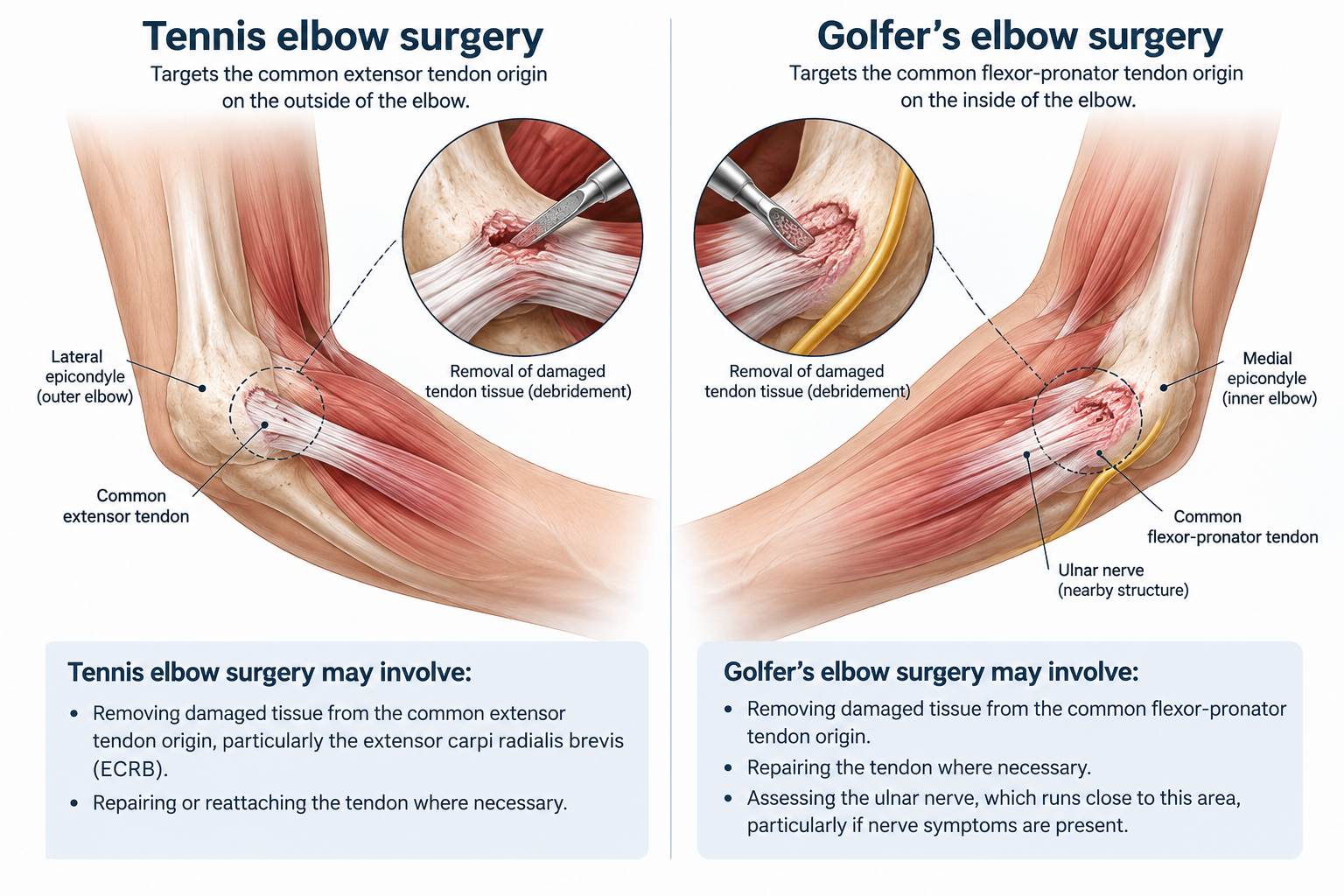
Yes. Although surgery for both conditions generally involves removing damaged tendon tissue and repairing the tendon where necessary, the location and tendons involved are different.
Surgery is generally considered when symptoms remain persistent despite an appropriate course of non-surgical treatment.
Mild elbow pain after an unfamiliar activity may improve with rest and changes to the activity that triggered it. However, consider seeing an orthopaedic specialist if:
Seek prompt medical attention after a significant injury if the elbow looks deformed, becomes very swollen or you are unable to move or use the arm normally.
Ultimately, the difference between tennis elbow and golfer’s elbow largely comes down to one question: is the pain on the inside or outside of your elbow? Tennis elbow affects the outer side, while golfer’s elbow affects the inner side.
Either way, the pain still needs to be managed appropriately, particularly if it is persistent or starting to interfere with everyday activities. If your elbow has been bothering you or isn’t improving, schedule a consultation with Dr James Tan in Singapore for an assessment and treatment plan.
Yes. It is possible to have pain on both the inner and outer sides of the same elbow, although the two conditions affect different tendon groups. Pain in several areas can also have another cause, so an assessment may be needed if the symptoms are persistent or widespread.
Computer use does not necessarily cause either condition. However, prolonged or repetitive use of the hands and forearms can contribute to elbow symptoms, particularly when combined with other activities that place repeated strain on the tendons.
Yes. Either condition can cause discomfort at night, particularly if the elbow or wrist is positioned in a way that aggravates the affected area. Night pain is not specific to tennis or golfer’s elbow, so persistent or severe pain should be assessed.
Yes. Irritation of a nerve in the neck can cause pain that travels into the arm, sometimes with tingling, numbness or weakness. These symptoms differ from the more localised tendon pain typically associated with tennis or golfer’s elbow.
Not necessarily. Complete rest is not always needed. You may instead need to temporarily reduce or modify exercises that aggravate the elbow, then gradually rebuild strength and return to your usual activities as your symptoms improve.

Get in touch with Orthopaedic Specialist Dr James Tan today to discuss your concerns and explore the best treatment options for your bones, joints, muscles and spine.


Monday - Friday: 8:30am - 5:30pm
Saturday: 8:30am - 12:30pm
Sunday & Public Holiday: Closed


